पवित्र मंदिर दर्शन
TempleShree MumbaDevi Temple
6:30 AM – 9:00 PM (trust's published schedule)
Bhuleshwar, Zaveri Bazaar, Mumbai – 400002
- Deity
- Mumbadevi (Mumba Aai)
- Present temple
- Mid-1700s
- Entry
- Free
The Story
About Shree MumbaDevi Temple
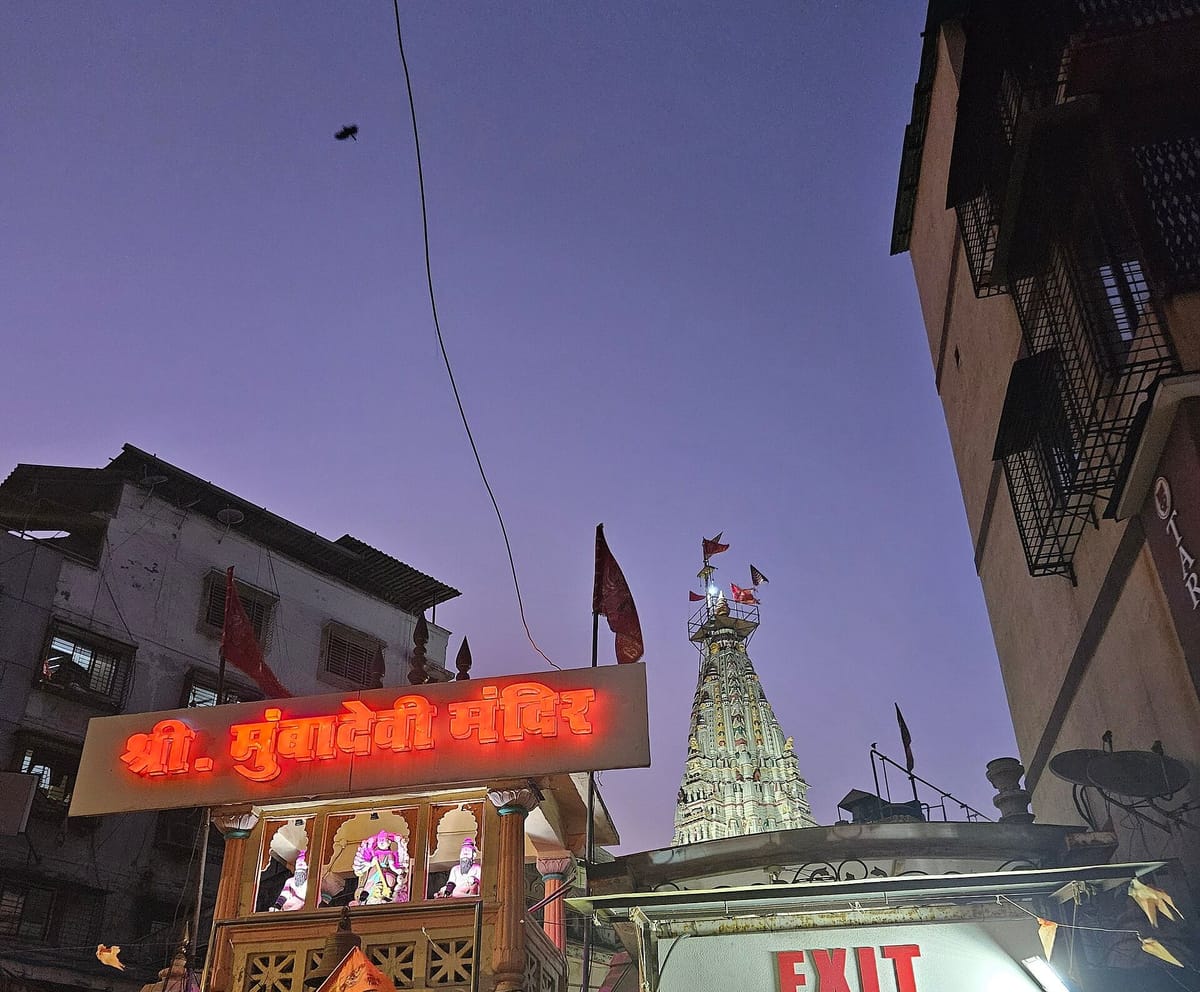
The spiritual heart of Mumbai, Shree MumbaDevi Temple is the namesake of the city itself. 'Mumbai' derives from 'Mumba Aai' — Mother Mumba — the fierce goddess worshipped here for centuries. Originally located where CST railway station now stands, the temple was relocated to Bhuleshwar in the 18th century and remains a powerful symbol of the city's identity.
History & Significance
Mumbai is named after this goddess. The 1909 Gazetteer of Bombay City and Island put it flatly — 'prolonged investigation leaves little room for doubt that the word Bombay is directly derived from the goddess Mumba, the patron deity of the pre-Christian Kolis, the earliest inhabitants of the island' — and Mumba Aai, Mother Mumba, is what the Kolis called her. Her original shrine stood near Bori Bunder, roughly where CSMT is now; it came down as the British expanded the fort and she was re-established on this Bhuleshwar site in the mid-1700s. The temple trust dates the original foundation to about 1675, though the Gazetteer implies her shrine here is considerably older still, recording that the old temples of Mumbadevi and Mahalakshmi were destroyed as early as 1318. In 1909 the Gazetteer judged that her shrine 'is accorded more general reverence than perhaps any other shrine on the island'. She sits today amid the gold and the noise of Zaveri Bazaar — a market that was already a bullion market when that was written.
Highlights
- The namesake of Mumbai — the city takes its name from 'Mumba Aai'
- The goddess in her silver crown, nose-stud and robes, in a wooden makhar
- Deeply tied to Mumbai's original Koli (fisher) community
- In the heart of the historic Zaveri Bazaar gold market
- Grand Navratri celebrations across nine nights
Through the Lens
A closer look at Shree MumbaDevi Temple
Real, free-licensed photographs of Shree MumbaDevi Temple — tap any image to view it full-screen.
Before You Go
Visitor tips
A few things worth knowing before you visit Shree MumbaDevi Temple.
- Early morning (6–8 AM) is the most peaceful time for darshan
- Combine with a walk through Zaveri Bazaar and Mangaldas Market alongside
- Visit during Navratri for an extraordinary nine-night festival
- Many small shrines surround the temple — worth a slow wander
- Parking is very difficult; arrive by taxi, auto-rickshaw or train
Plan Your Darshan
Aartis, trains & the right day
Aarti Schedule
| Mangal aarti (opening) | 6:30 AM |
| Madhyan aarti | 12:15 PM |
| Evening aarti | 6:30 PM |
| Shej aarti (close) | 8:50 PM |
Commonly published schedule — timings shift on festival days; we confirm on the day of your tour.
Nearest Stations
| Kalbadevi (Metro Line 3) | ≈ 0.7 km — nearest since 2025 |
| Masjid (Central / Harbour) | ≈ 0.8 km |
| Marine Lines (Western) | ≈ 1 km |
Crowd Calendar
Best time: Weekday mornings, 6:30–8 AM, before the bazaar wakes
Busiest: Navratri nights and the midday Zaveri Bazaar rush, when the lanes barely move
Quick Answers
Frequently asked questions
What are Mumbadevi temple timings?
The temple trust publishes 6:30 AM to 9:00 PM, with darshan until about 8:55 PM and aartis through the day — 6:30 AM, 9:30 AM, 12:15 PM, 6:30 PM, 8:00 PM and 8:50 PM. Unusually for a Mumbai temple, no midday closure is published. Timings shift on festival days, so confirm before a special trip.
Is Mumbadevi temple closed on Mondays?
A great many travel sites say it is. We could not confirm it, and we think it is worth telling you why rather than just repeating it. The temple trust's own published schedule lists a full daily programme — darshan from 6:30 AM to 8:55 PM with six aartis through the day — and mentions no weekly closure at all. The sites that claim a Monday closure also disagree with each other about the opening hours, which is usually a sign of copying rather than visiting. If you are making a special trip on a Monday, call the temple office first on 022 22424974.
Why is Mumbai named after Mumbadevi?
Because of the goddess, not the building. The 1909 Gazetteer of Bombay City and Island concluded that 'the word Bombay is directly derived from the goddess Mumba, the patron deity of the pre-Christian Kolis, the earliest inhabitants of the island', and a later volume calls this generally admitted. Mumba Aai means Mother Mumba. The name attached to the island because her shrine stood on it — so it is more precise to say the city is named after the goddess whose shrine this is than after this particular structure, which is an 18th-century replacement.
Which station is nearest to Mumbadevi temple?
Kalbadevi on Metro Line 3 is now the closest at roughly 0.7 km, having opened in 2025. On the suburban network, Masjid (Central/Harbour) is about 0.8 km and Marine Lines (Western) about 1 km. Many guides name Charni Road as nearest — it isn't, it's the furthest of the four. All of these are straight-line distances; walking through the bazaar lanes takes longer than the numbers suggest.
How old is the Mumbadevi temple really?
Older than the building. The structure you visit dates from the mid-1700s, built to replace the shrine near Bori Bunder. The temple trust dates the original foundation to about 1675. But the 1909 Gazetteer records that the old temples of Mumbadevi and Mahalakshmi were destroyed in 1318, which needs a shrine here nearly 360 years before 1675. The honest answer is that the goddess's presence on this island is medieval at the latest; the building is Georgian.
Is it true the idol has no mouth?
It is widely said, including by Maharashtra's tourism department, and is explained as marking her as the silent earth-mother who listens rather than speaks. We pass it on as what is said rather than as established fact: we could not find it in any historical description of the temple, including the very detailed 1909 Gazetteer account, which describes her crown, nose-stud, necklaces and robes in fine-grained detail and would likely have mentioned it.
Who is Mumbadevi, and what is her connection to the Kolis?
She is a form of the Mother Goddess and the patron deity of the Kolis, the fishing community who were the island's earliest inhabitants. The strongest evidence of her hold on them is a custom the Gazetteer recorded in 1909: among the Kolis and other local Marathi-speaking castes, a bride and bridegroom were brought to her shrine on or after the wedding day to present a coconut, a bodice or a jewel according to their means, hoping she would keep their future free from ill-luck. That is the clearest answer to why people come — to place a new life under her protection.
Why is a major temple inside a jewellery market?
The market grew around her, not the other way round. By 1909 the street beside the temple was already described as one of the richest in Bombay, its northern half the Sona-Chandi Bazaar holding the gold, silver and precious stones the great merchant houses dealt in. Zaveri Bazaar is not a modern accretion around an old shrine — the two have been neighbours for well over a century. Walking in through the lanes is genuinely part of the experience.
Can non-Hindus visit, and is there a fee?
Yes, and no fee. There is no religious restriction on entry and darshan is free. Vehicle access into the bazaar lanes is difficult, so come by train or metro and walk the last stretch.
Getting There
Find it on the map
Ready to visit Shree MumbaDevi Temple?
Weave it into a private, chauffeur-driven Mumbai darshan — hotel pickup, an AC vehicle and door-to-door care from start to finish.